
A Lettre Gourmande from France
French bread for kids
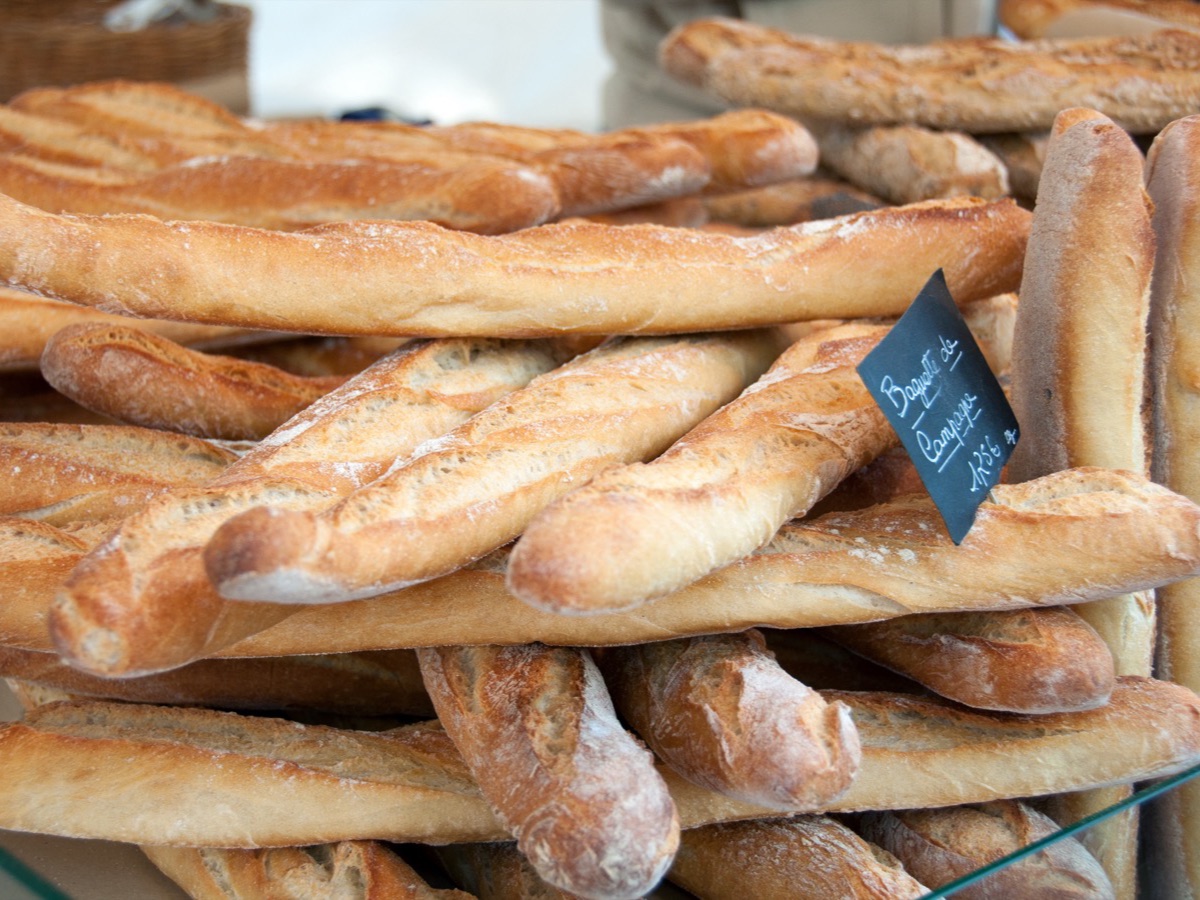
French bread for kids: bread plates in the Middle Ages, the bread that started a revolution, the birth of the baguette and a bread for every region.

Bonjour!
It's Nathalie! It's getting rather cold now, autumn has well and truly settled in, and I think it's the perfect time to introduce you to my brand-new letters, all about one very special side of France: its food! So welcome to your very first "Lettre Gourmande" (Gourmet Letter)!
Recently, on my walks in the fields, I have often seen farmers sowing their wheat: it will grow slowly, all winter long, and will be harvested next summer, to become flour.
Today, I'm going to tell you about a food that French people eat almost every day. It is crunchy on the outside, soft on the inside, and when you walk past a bakery, or when it comes out of the oven, its lovely smell makes you hungry straight away… Have you guessed? It's bread, of course!
Read it in French
C'est Nathalie ! Il fait maintenant plutôt froid, l'automne est bien installé, et je pense que c'est le moment idéal pour te faire découvrir mes toutes nouvelles lettres dédiées à un aspect tout particulier de la France : sa gastronomie ! Bienvenue donc dans ta toute première « Lettre Gourmande » !
Récemment, lors de mes promenades dans les champs, j'ai souvent vu les agriculteurs semer leur blé : il va pousser doucement, tout l'hiver, et sera récolté l'été prochain, pour devenir de la farine.
Aujourd'hui, je vais te parler d'un aliment que les Français mangent quasiment tous les jours. Il est croustillant à l'extérieur, moelleux à l'intérieur, et quand on passe devant une boulangerie, ou qu'on le sort du four, sa bonne odeur donne tout de suite faim… Tu as deviné ? C'est le pain, bien sûr !
Nathalie
In this letter
- A very long history
- Bread for the people
- The birth of the baguette
- At the boulangerie
- Bread at the table
- A bread for every region
- The words of bread
Bread and baguette facts
- The first leavened breads, nice and puffed up, come from ancient Egypt, more than 5,000 years ago.
- In the Middle Ages, there were no plates: food was put on thick slices of stale bread called "tranchoirs" (trenchers).
- Around 1840, Auguste Zang opened a "Viennese bakery" in Paris and introduced Parisians to the kipferl, the ancestor of the croissant. That is why croissants are called "viennoiseries".
- The word "baguette" appeared at the beginning of the 20th century, and since 2022 the skills to make it have been on UNESCO's list of Intangible Cultural Heritage.
- Every day, 12 million French people go to the boulangerie, and more than six billion baguettes are made every year.
- Since 1993, a baguette sold as "une tradition" can only contain flour, water, salt and yeast or sourdough.
- Every year, the winner of the competition for the best baguette in Paris delivers bread to the President, at the Élysée Palace, for a whole year.
- The word "copain" (friend) comes from the Latin "cum panis", "with bread": a copain is someone you share your bread with.
French words to learn
| Français | English |
|---|---|
| le pain | bread |
| la boulangerie | the bakery |
| le boulanger / la boulangère | the baker |
| le blé | wheat |
| la farine | flour |
| la levure | yeast |
| le four | the oven |
| la croûte | the crust |
| croustillant | crunchy |
| moelleux | soft |
| rassis | stale |
| une tartine | a slice of bread and butter |
| le goûter | the afternoon snack |
| la nappe | the tablecloth |
| saucer | to mop up the sauce |
| partager | to share |
| un copain | a friend |
| une région | a region |
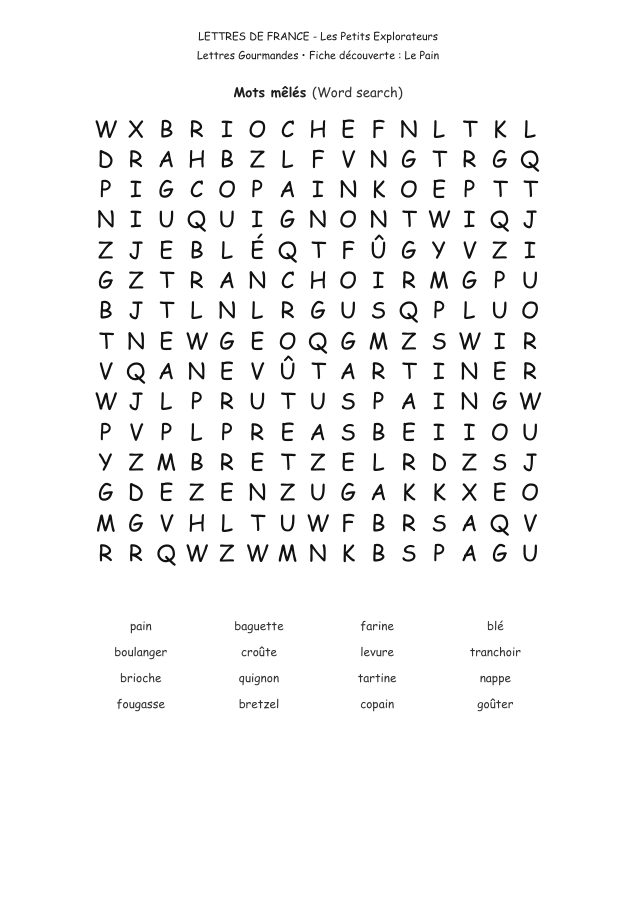
Free printable: French bread word search
Find 16 French words about bread, from "baguette" to "quignon", in this word search from the Discovery Sheets that come with the letter. Print it on A4.
Download the PDFMore free French word searches
The full Discovery Sheets come with every letter. Your first letter is free.
Recipe: Pain perdu (French toast)
In France, stale bread is never thrown away! When a baguette has gone hard, it becomes pain perdu, which literally means "lost bread": slices soaked in milk and egg, then fried in butter until golden. It is called French toast, or even eggy bread, in England. It makes a delicious goûter or breakfast, and a clever way not to waste food. Brioche makes an extra soft pain perdu, and a slightly stale baguette makes a crunchier one: try both and choose your favourite!
Prep 10 min · Cooking 10 min · Serves 4
Ingredients
- 8 slices of stale bread (baguette, country bread or brioche), about 2 cm thick
- 2 eggs
- 250 ml milk
- 2 tablespoons caster sugar
- A few drops of vanilla extract
- A pinch of cinnamon (optional)
- A knob of butter, for the pan
- To serve: jam, honey, fruit or a sprinkle of sugar
What you need
- A shallow dish
- A fork or a whisk
- A frying pan
- A spatula
Method
- In the shallow dish, beat the eggs with a fork. Add the milk, the sugar, the vanilla and the cinnamon, and mix well.
- Dip each slice of bread into the mixture for a few seconds on each side: it should be soft, but not falling apart. The staler the bread, the longer it can soak!
- With an adult: melt the butter in the frying pan over a medium heat.
- Cook the slices for 2 to 3 minutes on each side, until they are golden and a little crunchy.
- Serve warm with jam, honey or fruit… bon appétit!
More letters from France
-
 France, the Hexagon
France for kids: its natural borders, its regions, its people, and the secret of its nickname.
-
 Prehistory and the Lascaux Cave
Prehistory for kids: Neanderthals, Cro-Magnon artists, and the four boys and a dog who found the Lascaux cave.
-
 The Eiffel Tower
The story of the Eiffel Tower for kids: a mad idea, 300 angry artists, 2.5 million rivets and the secret that saved it.
-
 Victor Hugo
 for kids: the boy who dreamed big, the book that saved Notre-Dame, 19 years of exile and 4,000 secret drawings.